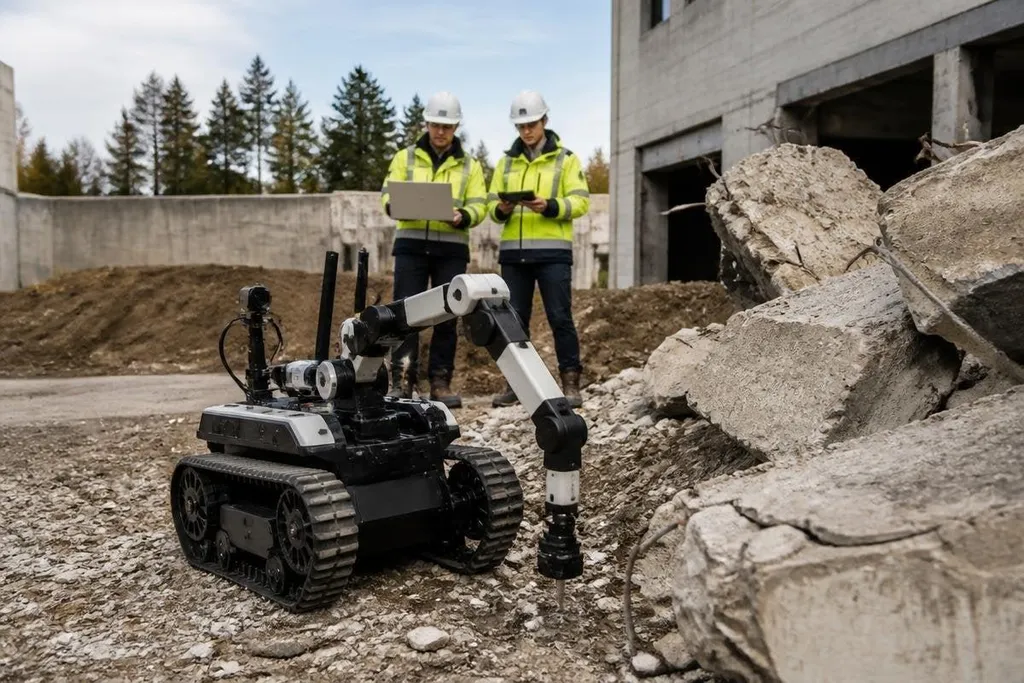
A robot bought with public money has to do more than move well in a demo. It must solve a task that matters to a public agency, work under strict safety rules, and justify its cost over time. That is why governments fund robots for defense, disaster response, public services, research, and industrial capacity.
Quick read
- Public robots handle work that is dangerous, remote, repetitive, or hard to staff.
- Research grants can reduce the cost and risk of building new machines.
- A working prototype still needs maintenance, training, safety checks, and a clear use case.
Public money targets hard jobs
Many government tasks take place where people face hazards or poor working conditions. Robots can inspect damaged structures, carry equipment through unsafe areas, collect data near chemical spills, or work in places that are too hot, cold, deep, or contaminated for a person.
The robot does not remove the need for people. Operators still plan missions, check sensor data, repair hardware, and decide what happens when conditions change. The value comes from keeping people farther from danger while the machine handles the first pass.
The same logic applies to remote work. An autonomous system can patrol a large site, inspect a long stretch of infrastructure, or map an area after an emergency. Its sensors give a public agency a record of the site before workers enter it, which can cut guesswork during the first hours of a response.
Robots can support public services
Governments also fund robots for work that is less dramatic but difficult to staff. A mobile robot may move supplies inside a hospital, inspect public buildings, or collect readings from roads, bridges, water systems, and other infrastructure.
These uses are easier to judge when the task has a clear measure. An agency can check how many inspections a robot completes, how often it needs human control, how long its battery lasts, and what the same work costs with people and conventional equipment.
That measurement matters because a robot can add work instead of removing it. Staff may need to charge batteries, clear routes, review false alarms, and fix sensor faults. A machine that saves field time but creates hours of daily supervision may be a poor purchase.
Public agencies also have to think about access and safety. A robot used around patients, passengers, or city workers needs clear rules for data collection, emergency stops, maintenance, and responsibility when something goes wrong.
Funding can build a local robotics base
Government money often reaches robots before a private buyer is ready to pay for them. Research grants can cover early prototypes, test sites, software, sensors, and safety work. That funding gives universities and companies a place to test machines against real conditions instead of relying only on lab results.
The wider goal can include local manufacturing and technical skills. A project may support work in motors, batteries, cameras, control software, grippers, or machine repair. Those parts matter because a public agency cannot depend on a robot it cannot service or replace when a supplier changes direction.
A public order can set a price and a test target for the wider market. The agency should tie payment to measured results, service access, and records from the working site. Reporting on public robot orders can show which claims reached a real deployment and which stayed in a proposal. That record matters before a grant is treated as proof of a finished product.
A grant can start useful work. It cannot prove that the final robot will operate for years at a sensible cost.
The limits of public investment
Government projects face a basic problem: the buyer is spending money collected from the public, so a persuasive demo is not enough. Officials need evidence that the machine works in the intended setting, that people can operate it safely, and that the total cost fits the task.
Field conditions expose faults that a controlled test may miss. Dust can affect cameras. Uneven ground can reduce walking speed. Wireless links can fail. A gripper that handles one object may struggle with another shape or surface.
The public also has to decide where automation belongs. A robot may improve inspection or reduce exposure to hazards, while a robot used to watch people or make decisions about public access raises harder questions about privacy, errors, and appeal.
I’d judge a public robotics project by its daily work, not by the quality of its launch video. The machine should have a named task, a human owner, a repair plan, and a result that officials can measure.
A practical test for public money
Before approving a robot program, officials should:
- Name the task and the place where the robot will work.
- Set a measure such as inspection time, uptime, human-control hours, or cost per mission.
- Test the machine in weather, terrain, lighting, and network conditions close to its real use.
- Budget for operators, spare parts, batteries, software updates, and training.
- Set rules for safety, data storage, access, and human review.
- Publish the result after the pilot, including failures and changes to the plan.
A robot earns public funding when it makes a defined job safer, clearer, or easier to repeat, and when the agency can show that result after the pilot ends. The next question is not how many robots a government can buy; it is how many can keep working after the grant money runs out.